When engineering teams hand you a specification sheet demanding materials with specific MPa values for compressive and flexural strength, do you ever feel like you’re deciphering a foreign language? This confusion isn’t just an academic hurdle; it represents a critical communication gap between engineering and procurement that can lead to costly errors in supplier vetting and product performance.
This article provides a material science deep dive to bridge that gap, offering a clear, comparative explanation of these essential material properties. We’ll begin by clarifying how compressive strength is measured and its applications, paving the way for a comprehensive understanding.
Defining a Material’s Resistance to Crushing Forces
You can think of compressive strength as a material’s fundamental ability to withstand axial loads that attempt to crush or reduce its size.
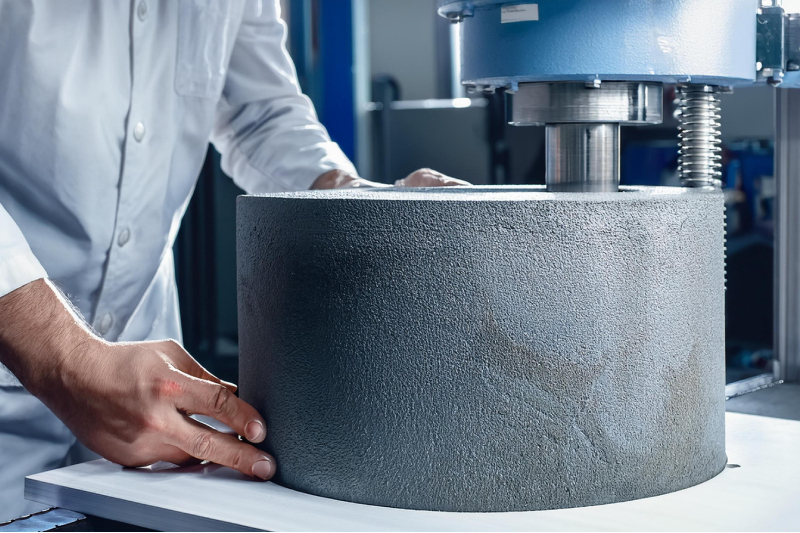
When you subject a material to compressive forces that push inward from opposite directions, it must resist this crushing pressure without undergoing permanent deformation. This property is quantified by compression testing, a standardized process where you apply a controlled axial force to a cylindrical sample until deformation or fracture occurs.
Consequently, compressive strength is essential for you to evaluate the load-bearing capacity in applications where materials support significant weight and pressure.
Case in Point: you rely on concrete’s high compressive strength in building foundations and columns to ensure structural integrity and prevent collapse.
Nevertheless, even a small reduction in compressive strength, such as a 5 MPa decrease, can risk structural instability, so you must verify testing adheres to standards like ASTM C39.
While resisting direct crushing forces is fundamental, you will find that many materials must also withstand more complex stresses, such as those encountered during bending.
Examining a Material’s Ability to Withstand Bending
Flexural strength, which is also known as bending strength or modulus of rupture, is the maximum stress that a material can withstand before failing under a bending load.
When you apply a bending force, it creates a complex stress state: tensile stress develops on the outer surface, while compressive stress occurs on the inner surface simultaneously. You measure this property using standardized flexural testing methods, with guidelines like ASTM D790 providing the framework for assessment.
The two primary methods, each with distinct setups and applications, are:
- The 3-Point Bending Test: You place a specimen on two supports and apply a load at the midpoint, but this can lead to stress concentration at the loading point.
- The 4-Point Bending Test: Distributes the load across a broader area, thereby subjecting a larger volume to uniform stress and reducing shear effects—making this test more accurate and preferred for brittle materials and composites, where defects can initiate premature failure.
Understanding these nuances of flexural testing highlights its inherent complexity and leads to critical differences when compared directly with compressive strength.
A Direct Comparison of Compressive and Flexural Strength
The primary distinction between compressive strength and flexural strength lies in how the force is applied during testing:
Compressive Strength Testing: Involves a simple, unidirectional pushing force, analogous to a hydraulic press crushing a material.
Flexural Strength Testing: Subjects the material to a complex combination of compressive and tensile stresses, as occurs when a beam bends.
For ductile materials like steel, compressive and flexural strength values are often similar due to their ability to deform plastically. However, for brittle materials such as concrete, flexural strength is significantly lower—typically only 10–20% of the compressive strength—because they are weak in tension.
Moreover, flexural tests are more sensitive to material defects; micro-flaws or surface imperfections can act as stress concentrators, initiating material failure on the tension side during flexural testing. Consequently, a material passing compression specifications might fail in flexural tests due to these imperfections.
Understanding these theoretical differences helps you determine which strength property is more critical for component performance in real-world applications.
Selecting the Right Material Property for the Application
To effectively translate the theoretical comparison into practical decision-making, your first step is to identify whether the component’s primary stress mode is crushing or bending. This determination is crucial because it dictates which property—compressive strength or flexural strength—must be prioritized as the key performance indicator during material selection.
Compression-Critical Scenarios: In applications such as building foundations supporting massive structural loads or medical implants that must endure body weight without deforming, high compressive strength is the non-negotiable parameter. It is essential for ensuring long-term integrity and preventing failure under high-pressure axial forces.
Flexural-Critical Scenarios: Conversely, for components in flexural-critical applications—like aircraft wings resisting aerodynamic forces or the beams and girders used in bridges and high-rise buildings—high flexural strength is vital. This property allows the material to withstand complex bending moments, thereby preventing fatigue and catastrophic failure.
Distinguishing between these application-driven requirements is fundamental to accurately interpreting material datasheets and making reliable choices that uphold performance and safety standards, which naturally leads into the article’s concluding summary.
Read More : A Builder’s Guide to High-Performance Exterior Finishes and Cladding
Transforming Material Data Into Strategic Decisions
The world of materials science is indeed complex, where balancing flexural strength with properties like durability is a critical task that engineers constantly face. When you grasp the physics behind compressive versus flexural strength, you evolve from being a passive participant into a strategic mitigator of material failure.
This insight empowers both engineers and procurement specialists to bridge their communication gap by demanding certified test reports and fully understanding application context.
Ultimately, this rigorous approach in your material science deep dive transforms your role from a cost center into the crucial lynchpin of product integrity.